
Prader-Willi Syndrome Awareness Month: Jordyn’s Story
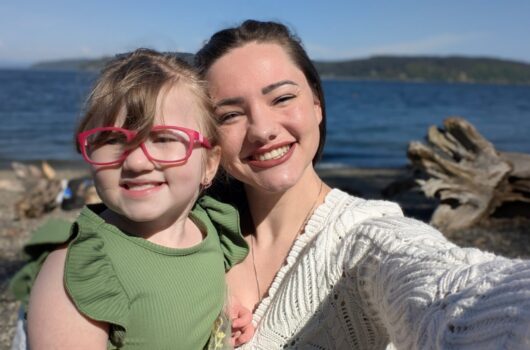
In honor of Prader-Willi Syndrome (PWS) Awareness Month, one of our medical assistants, Paige, shared the story of her daughter Jordyn-a story of advocacy, resilience, early diagnosis, and hope.
Jordyn was born in October 2021 during a severe rainstorm in Western Washington. Almost immediately, Paige sensed something was wrong.
“As a medical assistant, I had worked with newborns before,” Paige shared. “Jordyn slept constantly, barely moved, wasn’t feeding, had very few wet diapers, and her reflexes were noticeably weak.”
Initially, providers believed her symptoms were related to general anesthesia from Paige’s C-section. But Paige trusted her instincts. As Jordyn’s father was preparing the car seat for discharge, Paige insisted the care team reevaluate her daughter.
“I demanded that the chief of staff, charge nurse, anesthesiologist, and Jordyn’s pediatric provider reassess her,” she said.
That decision changed everything.
A provider from Seattle Children’s Federal Way Clinic examined Jordyn and immediately recognized that something more serious was happening. Jordyn was rushed to the NICU, where she was placed on continuous monitoring and given a feeding tube. After about 10 days at St. Joseph Medical Center, she was transported by ambulance-alone in an incubator-to Seattle Children’s because weather conditions prevented an airlift.
“That was the first time I had ever been separated from her,” Paige recalled.
At Seattle Children’s, extensive testing revealed that Jordyn had Prader-Willi Syndrome caused by a complete deletion of chromosome 15 on her paternal side. PWS is a rare genetic disorder affecting approximately 1 in 30,000 people.
Doctors also discovered several additional rare and unrelated conditions, including an ectopic and underdeveloped hypothalamus and pituitary gland, along with dextrocardia-a condition in which the heart is located on the right side of the chest without reversal of the abdominal organs.
The prognosis was uncertain.
“We were told she might never walk, talk, or eat independently,” Paige said.
Today, Jordyn is proving those predictions wrong.
“She is thriving in every area.”
PWS is a complex endocrine and metabolic disorder that affects nearly every system in the body. Individuals with PWS may experience low muscle tone, growth hormone deficiencies, endocrine disorders, scoliosis, developmental delays, feeding difficulties in infancy, and later, hyperphagia-an intense and persistent feeling of hunger caused by dysfunction in the hypothalamus.
Paige says caring for Jordyn has transformed her understanding of medicine and deepened her compassion for people living with eating disorders and metabolic conditions.
“She has taught me so much and broadened my interest in endocrinology and metabolic syndromes,” Paige shared. “She’s also made me incredibly sympathetic to every aspect of eating disorders, from anorexia to PWS.”
Jordyn recently began treatment with VYKAT XR, one of the newest FDA-approved medications for PWS-related hyperphagia. While newer therapies offer hope, managing PWS remains a lifelong challenge for families and caregivers.
But Jordyn’s impact reaches far beyond her own journey.
At the time of her birth, St. Joseph Medical Center did not have the genetic testing capabilities needed to diagnose PWS onsite, which contributed to her transfer to Seattle Children’s. Today, because of increased awareness and experience sparked in part by Jordyn’s case, the hospital now offers testing for the condition.
“When I meet local parents, they often say, ‘Wait-you’re the mother of the baby who helped St. Joe’s start testing for PWS?’” Paige said.
Jordyn has also helped other families receive earlier diagnoses. Paige says providers in Pierce County are now more familiar with what PWS can look like in newborns, allowing children to receive care sooner.
In fact, Jordyn has already unknowingly helped multiple local families navigate their own diagnoses.
And despite everything Jordyn faces, Paige says one comment still surprises her the most: “People always say, ‘But she looks so normal.’”
That’s exactly why awareness matters.
Prader-Willi Syndrome has only been recognized medically since 1956-less than 70 years ago. While rare, awareness, early diagnosis, specialized care, and continued research can dramatically improve outcomes for children like Jordyn.
This PWS Awareness Month, we honor Jordyn’s strength, her family’s advocacy, and the many individuals and families living with rare genetic disorders every day.